Hugging Face Launches TRL v1.0: The New Standard for Post-Training AI
Hugging Face has released TRL v1.0, a comprehensive library designed to streamline post-training workflows for large language models. This update unifies Reinforcement Learning from Human Feedback (RLHF) and other alignment techniques under a single, modular framework.
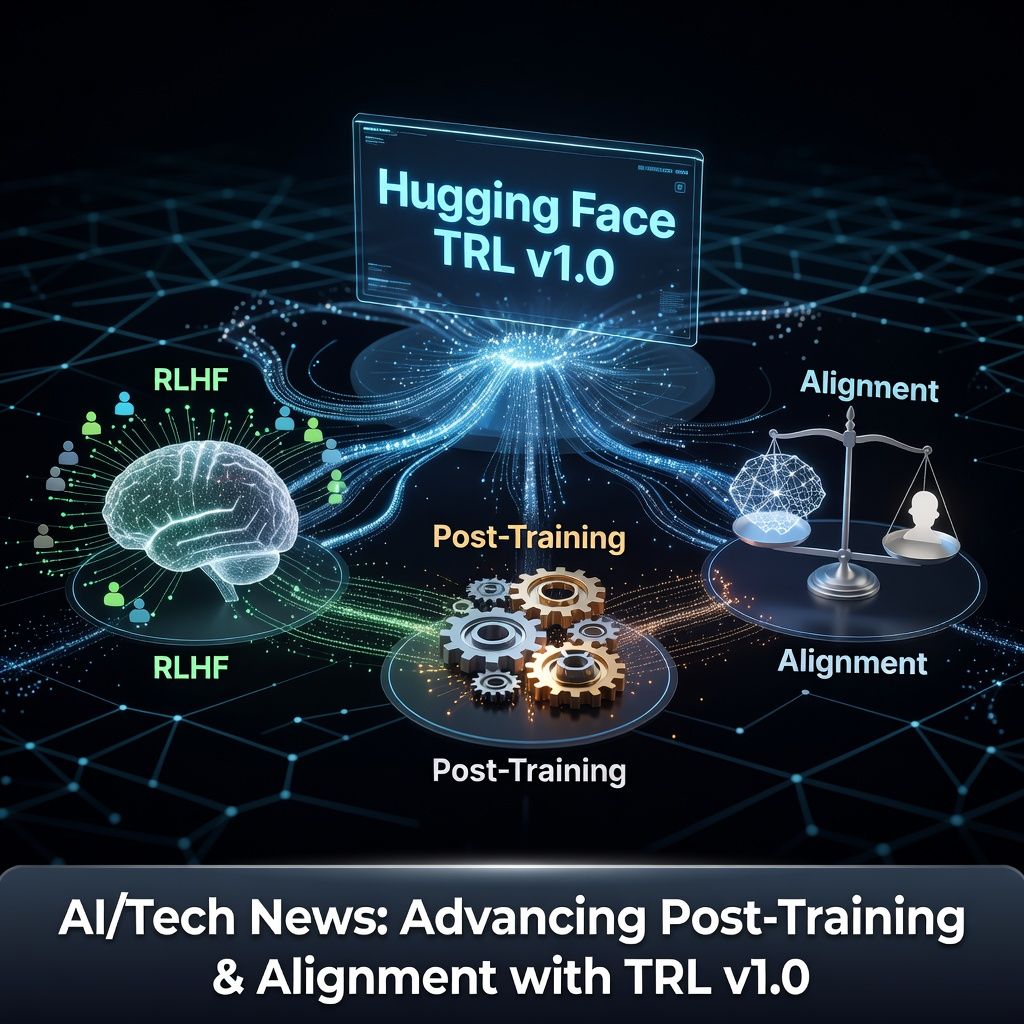
Hugging Face has officially launched version 1.0 of the Transformer Reinforcement Learning (TRL) library, marking a significant milestone in the open-source ecosystem for AI alignment. The release consolidates various post-training methodologies, including Supervised Fine-Tuning (SFT), Direct Preference Optimization (DPO), and Reinforcement Learning (RL), into a cohesive, production-ready toolkit. By standardizing these complex workflows, the library aims to lower the barrier to entry for researchers and engineers looking to align models with human preferences without maintaining disparate codebases.
The significance of TRL v1.0 lies in its ability to decouple the training pipeline from the underlying model architecture, allowing for rapid iteration and experimentation. Previously, implementing advanced alignment strategies often required deep, custom engineering knowledge, leading to fragmented implementations across the community. This new unified approach not only simplifies the code but also ensures reproducibility and stability, addressing a critical pain point in the industry where alignment research often struggles to transition from academic notebooks to scalable production environments.
Looking ahead, the release invites the community to contribute to a more robust and flexible alignment stack. As the field of AI evolves, TRL v1.0 positions itself as the foundational layer for future alignment research, promising better tooling for the next generation of models. The immediate focus will likely be on expanding support for emerging alignment algorithms and optimizing performance for large-scale distributed training, ensuring that open-source developers can keep pace with proprietary advancements.